Showing posts with label Rick Ambrose. Show all posts

Sunday, December 30, 2012

The Phenomenal BMW 8 Series E31


The 8 Series: The Most Beautiful BMW Ever Produced.


For the entire 80's decade, BMW's 6 Series epitomized the pinnacle of styling and elegance in a personal luxury coupe. The crisp lines and perfect proportions of the design earned it a home in the permanent collection of the Museum Of Modern Art. Production ended with the 1989 Model, available as the 635csi in automatic and 5 speed manual ended production in April 1989 with only 650 units made for the USA. Total production in 14 years of the 6 Series was about 86,000 units worldwide

The luxury version with hand-stitched Italian glove leather throughout the cabin, designated the L6, and the M6 a hand-built variant designed for performance driving, were only available for 1987 and 1988. Prices ranged from about $40k to $50k.

The BMW 635csi

A successor to the 6 Series was anxiously awaited by the faithful, with spy photos and news leaks starting with development of the new model on 1986. What BMW did not communicate well to the public was that the E31 8 Series was intended as a new model featuring state of the art and break-though technologies, designed to push BMW further up-market.


BMW spent an extraordinary amount of time and money on the E31 development. Over $1 Billion US had been invested before a single example rolled out of the factory.
BMW commissioned Artist David Hockney To Create An 8 Art Car 

Arriving in the US in 1990 as a 1991 model, the enthusiastic reaction to the stunning exterior styling was immediately followed by a gulp when potential buyers learned the MSRP was literally twice the price of the 6 Series. While BMW had brought to market " a Ferrari you could drive every day", they also left a void in their product offering for a 2 door coupe as wide as the Grand Canyon: BMW did not offer a 2 door coupe between the $30k 3 Series and the 850i, introduced at an eye-popping $90k+

BMW designers added high-beam flashers into the grille lights for passing slower traffic so the headlights would not need to be raised; Fascia alludes to the M1. 
The simple, clean almost Kamm-back design of the 8 Series tail.

With a computer-aided body created to achieve a .29 drag coefficient and styling overseen by an Italian head of styling, the BMW 850i 12 cylinder was the first production car to utilize 
" drive by wire " technology eliminating the mechanical connection between gas pedal and engine speed; seat structure was reinforced to incorporate the driver and passenger seat belts, allowing designers to eliminate the B-Pillar and ( with the exception of the Mercedes SEC ), create the first hardtop coupe seen since the 1970's. Initial years featured a very sophisticated multi-link rear suspension.

The first hardtop coupe seen in the US since the 70's, the 8 Series has no B-Pillar. This car features
the sport aluminum and directional light alloy rims.

Initially only one model was available in 4 speed automatic or 6 speed manual. Both were motivated by a V12 - basically two in-line 6 cylinder engines mated together with a output of just shy of 300HP. A rare 396 HP 850csi would appear with an M engine.


The 850csi Test Drive Profile From the UK
Absolutely Beautiful Styling From Ever Angle. 1994 Models added the turn signal indicator behind the front wheel arch.

Unfortunately for BMW, the 8 Series introduction was inconveniently timed with a world-wide recession, spiking gas prices, and a war in the Gulf. Add then there was the price. Once gas-guzzler taxes, state sales taxes and dmv registration were added, this was a $100k car.
Buyers hoping to replace their 6 Series walked across the street to Mercedes and the new kids on the block, Lexus and Infiniti - or just decided the 5 Series was more appropriate.

Placing the gas door panel over complex creases in the body is a testament to the quality and confidence of BMW's manufacturing processes.

US sales were so disappointing, BMW decided to amortize the development costs by introducing a lower-priced 8 cylinder version in 1994 - the 840ci. Except for having round
quad exhaust pipes, the cars were visually identical.


(Above) Top Gear's Jeremy Clarkson Tests The 850csi
(Below) Top Gear's Richard Hammond Tries Out A Used 850ci


In many respects, the 840ci was actually the better car, as agreed by Autoweek in the article above.  With less than a 10Hp difference between the 8 and 12 cylinder cars, buyers had difficulty justifying paying $30k more for the 850. The lighter weight of the 8 cylinder also made the car feel more nimble, and average gas mileage could be almost twice as good in regular driving, achieving close to 25 mpg highway. Oddly, the exhaust note of the 840ci also sounded better, giving off a throaty powerful rumble as opposed to the 12 cylinder's silky smooth and subtle operation.
All business in the 1994 8 Series cabin. Wood trim would be added in 1995 to the console.
On-Board Diagnostics, 2 zone temperature controls, ASC and heated seats with lumbar adjustment were standard. At speeds in excess of 90mph, all windows and sunroof automatically close themselves - creating quite a surprise to the unaware driver.
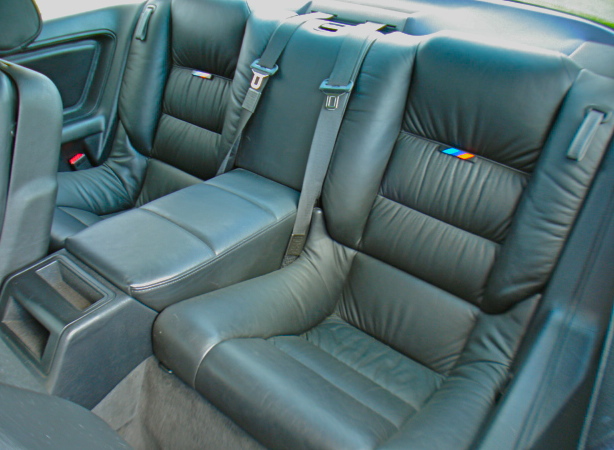
Rear seating was 2+2 style and unfortunately lacking any legroom due to the front seat structure. 1994 models allowed the rear seat backs to fold down, creating a very usable rear shelf.
Nappa leather covered seating and sections of the door panels. Frameless side windows close into the roof, automatically lowering once the door handles are touched.
The thin and graceful C-Pillar afforded excellent driver visibility. The center of the rear seat back hides a ski bag pass-thru into the trunk.
The 8 Series trunk is unexpectedly large and useful. two batteries - made specifically for the car, are stored in the side panels, as is the CD changer. Fully carpeted, a complete tool kit resides in the lid.

Production of the E31 ended for the US in 1997, but continued in Europe through 1999.
Total US sales for the entire 1991-1997 model years totalled only 7232 cars - 75% LESS than BMW had anticipated. 

Worldwide, about 30,000 E31's in all configurations were assembled, making BMW's development costs PER VEHICLE nearly $35,000 before the first part was assembled. 
This was one-third the number of 6 Series sold.

Despite it's sales failure, the 8 Series remains extremely popular among those fortunate to own them, and many consider it to be the most beautiful BMW ever produced.


About This Specific Car:

This 1994 BMW 840ci is finished in original factory Schwartz Black with Black Leather Interior and optional Directional Sport Alloy Wheels. A two-owner car currently with 80,000 miles, it remains in my personal collection; my car of choice when taking a 100 mile+ drive. 

Thinking of Buying An 8 Series?

Owning an e31 8 Series affords admission to a very exclusive club. While seen regularly in California, they are extremely rare throughout the rest of the US. In the 3 years I have owned this 840ci, I have not passed another 8 Series on the road. My local BMW dealer had NEVER seen one.

Having owned both the 12 cylinder 850i and the 840ci above, I would highly recommend the 840ci as the overall better choice- unless you want a manual 6 speed. The cars are visually identical, the horsepower and performance in real-world driving is about the same, and the gas mileage is great for a 300 HP V8 at 17- 25. More importantly, engine components are shared with the 5 and 7 Series of the era, so far less costly than the V12 - which seems to have two of everything.

Trim and cosmetic parts are VERY expensive with most requiring air freighting from Germany. Most BMW dealers have little to no experience working on these cars outside of California, so finding a knowledgeable mechanic is crucial. 

Proper adjustment of the windows is important re: wind noise, water intrusion and simply to keep them from not breaking. A common and annoying problem related the General Module causes the door locks, wipers, courtesy locks and trunk to stop operating below approx 40 degrees F. The problem this really creates is that the windows - which seal into the roof channel - will not drop, and therefore you will not be able to get into the car.

Because of the EXTREME limited production pay up at acquisition and buy the best example you can find. It will save you thousands of dollars.

Questions about the E31 8 Series?....email me!


1966 Ford Thunderbird Town Coupe

New For 1966:The Private World Of Thunderbird.


After of the Mustang, Thunderbird is probably the most iconic Ford model nameplate of the last 50 years. From 1955 through 1966, it was indeed " Unique In All The World."


Introduced in 1955 as a two-seater to compete against Chevrolet's Corvette, product planners in Dearborn reasoned that by adding room for two more passengers, they could increase sales...and they were right. So out went the sport and in came the luxury, with a 2 seater T-Bird not to return until 2001.


The second generation know as the " Squarebird " ran from 1958 thru 1960, followed by the Space Age influenced "Bullet Bird" from 1961 to 1963. These two 4 passenger TBirds  created a new class of automobile: The premium personal luxury coupe and convertible.


In 1964, Thunderbird returned with a dramatic new appearance that hearkened back to the Squarebird. Long hood, short deck with a coke-bottle side sculpture design that completely abandoned the clean missile design of the previous car. Although making no pretense at being a sports car, V8 power was still important and Thunderbird came with a standard 390
or an optional 429.


Thunderbird for 1964 offered a hardtop coupe, vinyl topped Landau as well as a soft-top convertible that retracted into the trunk, similar to the mechanism used by the iconic Lincoln Continental. For 1965  there were minor changes to the front fascia and forward-canted side trim behind the front wheel wheel.


1966 would be the final production year for the model, and what many orthodox collectors believe to be the final collectible Thunderbird. Four Models were offered: A base hardtop with four side windows, a convertible, a Landau with an enlarged c pillar, featuring a vinyl top in an alligator grain with a sweeping "S" bar and simulated wood dash trim;  the Town Coupe which was basically a toned-down Landau without the c-pillar adornment and usually without a vinyl roof with brushed stainless dash trim.


Exterior Styling  changes were received warmly and many consider 1966 as the best looking of the three-year run. New was a singular taillight lens running the width of the entire car, complete with the sequential turn signal system introduced in '64. The 1966 egg crate grille prominently featured a turquoise embedded Thunderbird; the quad headlights were now surrounded by a ribbed chrome insert.


Ford marketed the Town Coupe and Landau as the higher-end models, noting that the
enlarged c-pillars allowing owners to " Experience The Private World Of Thunderbird."
That worked both ways though, as neither the rear seat passengers nor the driver could see
out beyond this slab of sheet metal, making lane changing challenging and putting the passenger side mirror to good use.


Throughout this generation, the interior remained pretty constant: Total Jet Age - inspired by the recent introduction of Boeing's 707 Jetliner. A " Swing Away" steering wheel allowed for graceful entry and egress; Four stainless looking orbs with green glowing surrounds housed
 the gauges for gas, oil pressure, temperature and battery charging. An overhead  "Check Console" alerted the driver to Low Gas, Seat Belts, Emergency Brake and Door Ajar. The electric window option included power vent windows.


Shown here from top to bottom: Hardtop, Landau and Town Coupe for 1966.


Rear passengers in "The Private World" relaxed in richly upholstered wraparound seating reminiscent of a rat pack cocktail lounge. Reading lights were provided as was an ashtray.


About This Specific Car:

This 3 owner 65,000 mile 1966 Thunderbird Town Coupe was finished in a beautiful Silver Mink Metallic with matching interior. In person, it was a pale aqua and quite stunning. Fully optioned with air conditioning, 6 way power driver's seat, electric side and vent windows, the rare five-spoke star hubcaps, fender skirts ( not shown) ,tinted glass, am/fm radio with front and rear speakers. Standard equipment included the console, thin shell bucket seats and hood mounted turn indicators. The trunk was fully upholstered in a plaid vinyl with match spare tire cover. Sold in 2001 to a new owner in San Francisco.


Restoring A Thunderbird:

Next to the Mustang, the Thunderbird is likely the least expensive and easiest Classic Ford
from the 1960's to bring back to new. Production was high, and after-market suppliers of new reproductions are plentiful. Mechanicals are shared with most Ford's of the era, Certain trim pieces specific to a model year or generation can be a challenge though - namely the stainless console and dash trim, the stainless panels that adorn the bucket seat backs, and
the door panels which are formed as one piece and easily crack from the stress of closing from the poorly-engineered pull handle.

 Important: The power door locks, air conditioning, remote trunk release and wipers are all vacuum operated - so one leak can crash them all....make sure to check these and listen for any hint of a hissing sound when the engine is on. The sequential taillights - originally a mechanical system - can be upgraded with an electronic aftermarket unit. 


The 1966 Thunderbird is an absolutely stunning car that can be purchased and restored at reasonable prices. It rides and drives beautifully both in town and on the freeway, and I highly recommend having one on your " bucket list".

Questions about restoring a 1966 Thunderbird?....email me!


Friday, December 28, 2012

Lincoln Refreshes The Continental for 1964

Lincoln Refreshes The Continental For 1964.

Lincoln stunned the world with introduction of the 1961 Lincoln Continental. Auto writers at the time universally praised the restrained classic styling, calling the Continental one of the most beautiful cars in the world....

For its fourth model year, the 1964 Continental received its first major styling update, adding 3 inches of wheelbase that translated into more rear passenger leg room, a streamlined horizontal dash, a slightly squared-off roof line and flat side window glass. Retained was the sweeping slab side profile and suicide center-opening coach doors. Safety equipment added seat belts, padded dash and emergency flashers.


Front Fascia featured a detailed egg-crate pattern separated by nine vertical bars; The rear motif complimented the grille a raised pattern both above and below the bumpers flanking the license plate. For 1964, the gasoline access door now moved from the trunk to the drivers side rear quarter panel.


Color Combinations offered the buyer an astonishing selection of color combinations in flat and metallic exterior hues, with cloth, leather or a combination of both. A silver thread Lincoln Star Insignia Brocade ( as shown below) was among the choices. Standard bench seating afforded comfort for six, although a very rare front bucket seat with console option also made its debut. 


For 1964, Lincoln updated the two-pod dash of the previous generation with a sweeping single horizontal design featuring air conditioning vents cleverly hidden within the chrome bar pattern. Options included Cruise Control, Electric Eye Automatic High Beam Dimmer and one of the first factory AM/FM radios.


The traditional rear view mirror bracket was replaced by a windshield mount; a Day/Night Mirror was standard, along with power locks, power side and vent windows, center arm rests and variable-speed wipers with washer. Gauges kept the driver informed of the fuel, battery, water temperature and oil pressure.

The door locks, a/c, wipers and glove box hidden trunk release were vacuum operated - not electric.


Weighing in with four passengers at over 6000 lbs, power was supplied by the time-tested 430 cubic inch V8
mated to a three-speed C6 automatic transmission. Horsepower was estimated at 300.


The Lincoln Continental's use of exquisite material continued to the door panels, adorned with chrome and brushed stainless steel window controls, door handles and grab handles. 


Gone was the real wood trim of the 1961 thru 1963 models, instead replaced by a vinyl simulated wood pattern at no additional charge. This Special Order example has rare the "Wood Trim Delete" option.


Like the original generation, the slab sides were
smooth and flat without any use of side profile sculpture line accents. The fender peaks featured a stainless steel peaked trim that ran the entire length.


Rear opening coach (suicide) doors continued on the Lincoln Continental through 1969. Only two models were offered - a sedan and the iconic convertible. Full dish hubcaps were standard. The spacious trunk was fully carpeted, as was the spare tire cover.


About This Specific Continental:

Purchased from the original owner in with 17,000 miles as shown, and sold in 2007 to a collector in Florida.
The data plate notes that this was a special order car, and is believed to have been featured at The Ford Pavilion of The 1964/1965 World's Fair in New York. A commemorative license plate was found in the trunk and can be seen on the front bumper in the above photo.


Notes For Collectors:

The Lincoln Continental can be an expensive collectible to restore, as much of the trim was limited to one or two model years: Figure about four times the cost of a Thunderbird or Mustang. Low annual production of approx 30,000 units makes quality used parts difficult to find. Ron Baker in CT is a very good source for
quality original and reproduction trim parts.

Thinking Of Buying? - What To Look For:
Because many trim items are specific to the model year and production was relatively low, it is recommended that buyers search for the best cosmetic example possible and pay up for it - it's much cheaper than having to restore yourself. 
This is a unibody car, so rust can present real structural problems in the lower door and wheel arch areas.
Parts for major mechanical systems are more easily obtainable, some being shared with other Ford products. The wipers, air conditioning, trunk release and door locks are all vacuum operated - not electric - so if one doesn't function - none of them will - so check carefully as diagnosis of the culprit is a Herculean task; The exhaust system is prone to cracked manifolds, especially on the passenger side. If the car is overheating, be aware that there are TWO thermostats. The car came factory equipped with FOUR mufflers/resonators.

It is also STRONGLY advised that the first item attended to be an update to a DUAL master brake cylinder as a single system was standard; the second thing to check is the steering column bushing and detente switch - which, if sloppy, can allow a parked Continental to slip from PARK into REVERSE by itself - automatically releasing the emergency brake - en route to taking out your neighbor's home as it rolls across the street....
Once restored, the 1964 Lincoln Continental will prove to be an enjoyable, luxurious and surprisingly-agile automobile for daily driving.
Questions about restoring a 1960's Lincoln Continental?...email me.